alumni stories
My Coaching Journey with Nicole
ACT Programs
Leadership Performance Coaching Certification
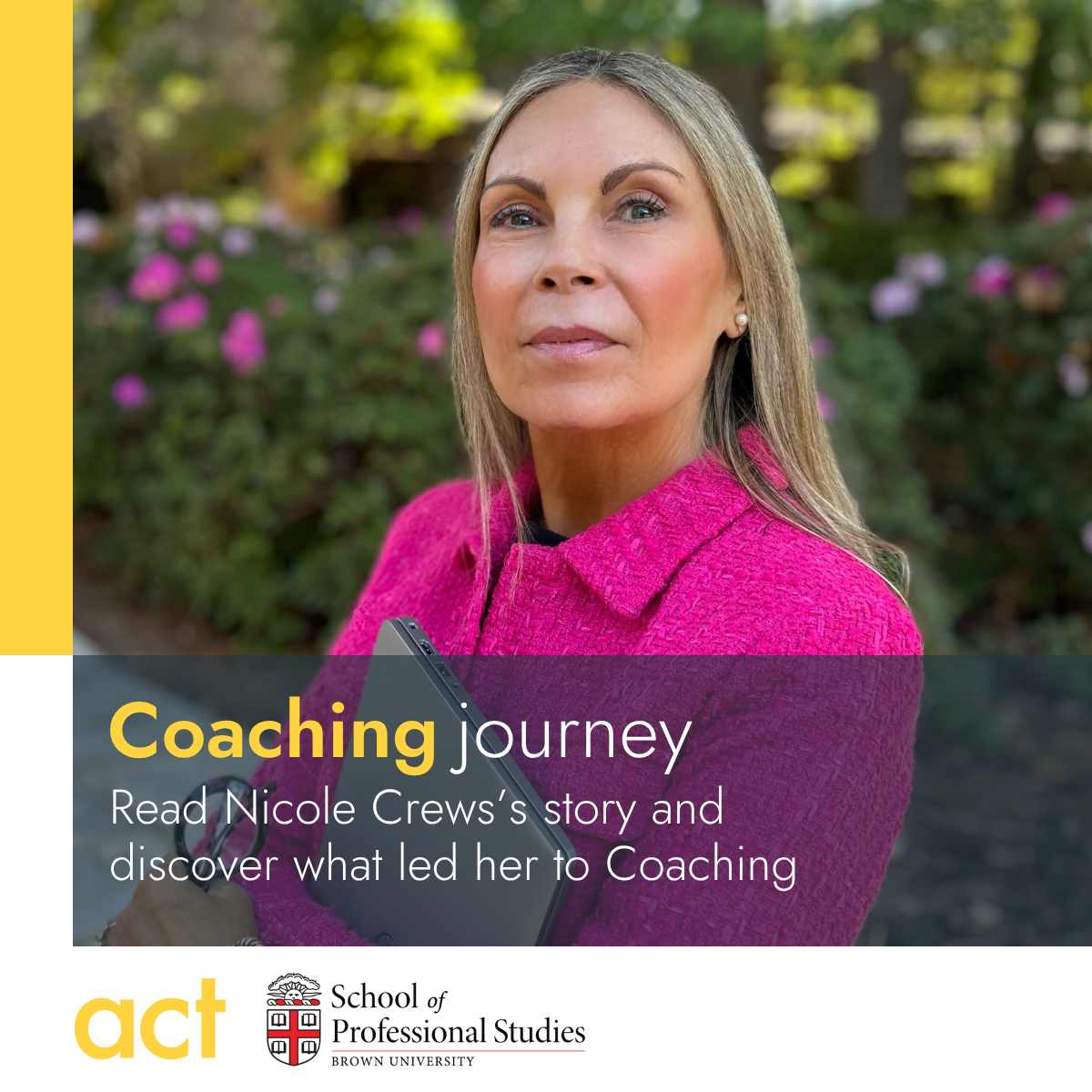

We believe the best way to understand the ACT/Brown Leadership & Performance Coaching Certification Program is through the voices of our graduates. This month, we’re delighted to feature Nicole Crews, an accomplished writer-turned-coach whose journey reflects the power of authenticity, values, and voice. Nicole shares how her background in ghostwriting led her to discover coaching, and how the ACT/Brown program helped her bring that passion to life.
What brought you into the world of coaching?
I came into coaching through the back door. For years, I was a ghostwriter working with CEOs, founders, and top experts in their fields. Again and again, something surprising happened: after we shaped their message on the page, they would ask me to coach them on how to become better writers themselves.
What I realized was that I wasn’t just teaching writing skills. I was helping them lean into their values, uncover their authentic voice, and claim a deeper sense of identity both as individuals and as leaders of their companies. Through writing, they gained clarity on who they were, what they stood for, and how to make decisions aligned with that truth.
That work was deeply rewarding, and it opened my eyes. Coaching didn’t just belong in the C-suite. Middle managers, people mid-career, anyone navigating leadership growth could benefit from the same process of reflection and alignment. I wanted to democratize coaching, to bring that kind of clarity and confidence to a broader community.
So I dug into the research and eventually found the Brown program, which gave me the tools to expand my practice. Looking back now, the transition feels natural: I started by giving leaders words, and discovered my real calling was helping them find their voice.
What inspires your passion for coaching?
For me, coaching has never been about serving only one narrow audience. I believe deeply in the democratization of coaching making it accessible across levels, backgrounds, and perspectives. Leadership doesn’t have a single look, title, or pedigree. It comes from people of all identities and experiences, and the world is better when those voices are cultivated, heard, and trusted. The world is a fascinating place and the more we understand ourselves and learn how to work together and communicate with each other, the better off we will be.
What skills that you learned from the LPCC program have you found most useful in your professional life? Do you have any advice on how to cultivate those skills?
Active listening is quite possibly the most powerful tool and anyone’s toolbox. Active listening is the practice of being fully present with another person, hearing not just their words, but also the meaning, emotions, and perspective behind them. It requires setting aside distractions and suspending the urge to respond too quickly so that the other person feels genuinely seen and understood. At its heart, active listening is about creating space for connection and trust, which in turn deepens relationships and strengthens communication.
Cultivating this skill takes intention. It can start with simple habits: putting away distractions, maintaining eye contact, and showing curiosity through open-ended questions. Reflection and paraphrasing help confirm understanding, while empathy allows you to tune into what’s being said beneath the surface. Like any practice, the more consistently it’s used, the stronger it becomes. Over time, active listening transforms conversations, helping people feel valued and opening the door to more meaningful relationships.
What are the current or upcoming challenges you're facing in the coaching field? How have you been meeting those challenges?
One of the biggest challenges in coaching right now is working within the reality of an economic downturn. Companies are tightening budgets, individuals are weighing every investment carefully, and coaching, though impactful, is sometimes seen as a luxury rather than a necessity. For clients with fewer resources, the barrier is even higher. They may recognize the value of coaching, but the cost can feel out of reach at a moment when financial pressure is already acute.
This becomes especially complex when the decision lies in the hands of senior leaders who hold the purse strings. Too often, investments in coaching are reserved for executives or top performers, while middle managers and emerging leaders, the very people who can benefit most are left out. My work sits in that tension: advocating for the democratization of coaching, finding creative ways to make it more accessible, and helping organizations see that supporting leaders at every level isn’t just a “nice-to-have,” but a critical investment in resilience and long-term growth.
Do you have any special projects that you're working on? Could you share any details?
In the face of today’s economic downturn, I’m choosing to see opportunity. Rather than pulling back, I’m leaning in by creating a special project: building content that showcases the power of coaching. My goal is to demonstrate, through real stories and practical insights, how coaching can help people navigate uncertainty, strengthen their leadership, and make grounded decisions, even when resources feel tight.
This project is about more than visibility; it’s about democratization. By sharing what coaching can do in accessible ways, I want to reach not just executives with large budgets, but also middle managers, emerging leaders, and individuals who may not have thought coaching was for them. Hard times can often spark the most meaningful growth, and I believe that by opening up the conversation around coaching, we can help more people discover tools that make them more resilient, confident, and authentic leaders.
Where do you hope your coaching journey will take you next? Or 5 years from now?
I envision building a body of work content, programs, and communities, that shows what coaching can do when it’s placed in more hands. I want to partner with organizations that are forward-thinking enough to invest in their people beyond the top tier, and I hope to create scalable ways for individuals with fewer means to benefit as well. Five years from now, my coaching will not just be about one-on-one growth, but about cultivating a broader movement of leaders who are values-driven, resilient, and equipped to meet the challenges of their time.
How has ACT helped shape the path you've taken (or plan to take) in your coaching journey?
The ACT program at Brown University has been foundational in the way I approach coaching. It gave me not only a strong theoretical grounding in evidence-based coaching practices, but also the space to explore my own style as a coach. Through the program, I learned to integrate neuroscience, leadership theory, and practical coaching tools in a way that helps clients uncover their authentic voice and align their actions with their values.
Please share some of your recent accomplishments (since completing the LPCC program).
Since completing the ACT program at Brown University in October 2024, I’ve been fortunate to reach several exciting milestones in my coaching journey. I earned my ACC credential as a member of the International Coaching Federation and re-launched my own coaching practice. Alongside my independent work, I also coach internally with the Center for Creative Leadership, which has given me the chance to work with a wide range of leaders and expand my impact.
What I’m most proud of is the diversity of the clients and communities I’ve been able to serve. I’ve had the privilege of working with displaced federal employees, Haitian refugees, and clients ranging from recent college graduates to recent retirees. My practice now spans people of all backgrounds, levels of education, and career stages. This breadth reflects what I value most in coaching: creating a space where everyone regardless of title, identity, or experience has the opportunity to find their voice, grow as a leader, and navigate change with confidence.
Nicole Crews on Linked In.

Hernan Torres and Nicole Crews - Isabel Bowen and the Center for Creative Leadership.
About ACT
A Leadership and Performance Coaching company focused on developing exceptional leaders, helping leaders become Aware of their impact so they can make better Choices leading to Transformative results.
Our commitment to transformative learning, innovation and diverse thinking, and making an impact in the world is at the core of what we do. We are a family-owned, service-driven company who partners with the Brown University School of Professional Studies, organizations and government agencies to deliver our life changing programs.
ACT, in partnership with Brown University School of Professional Studies, an international leader in executive education, is excited to offer ACT’s ICF accredited Leadership and Performance Coaching Certification Program. ACT shares Brown University’s mission to develop reflective leaders, to effect change in the world, and to improve human welfare. https://actleader.com/
Read other articles
our alumni