alumni stories
My Coaching Journey with Kamrin
Company
Kamrin Huban Coaching, LLC
Job Title
Executive Leadership Coach
ACT Programs
Leadership Performance Coaching Certification
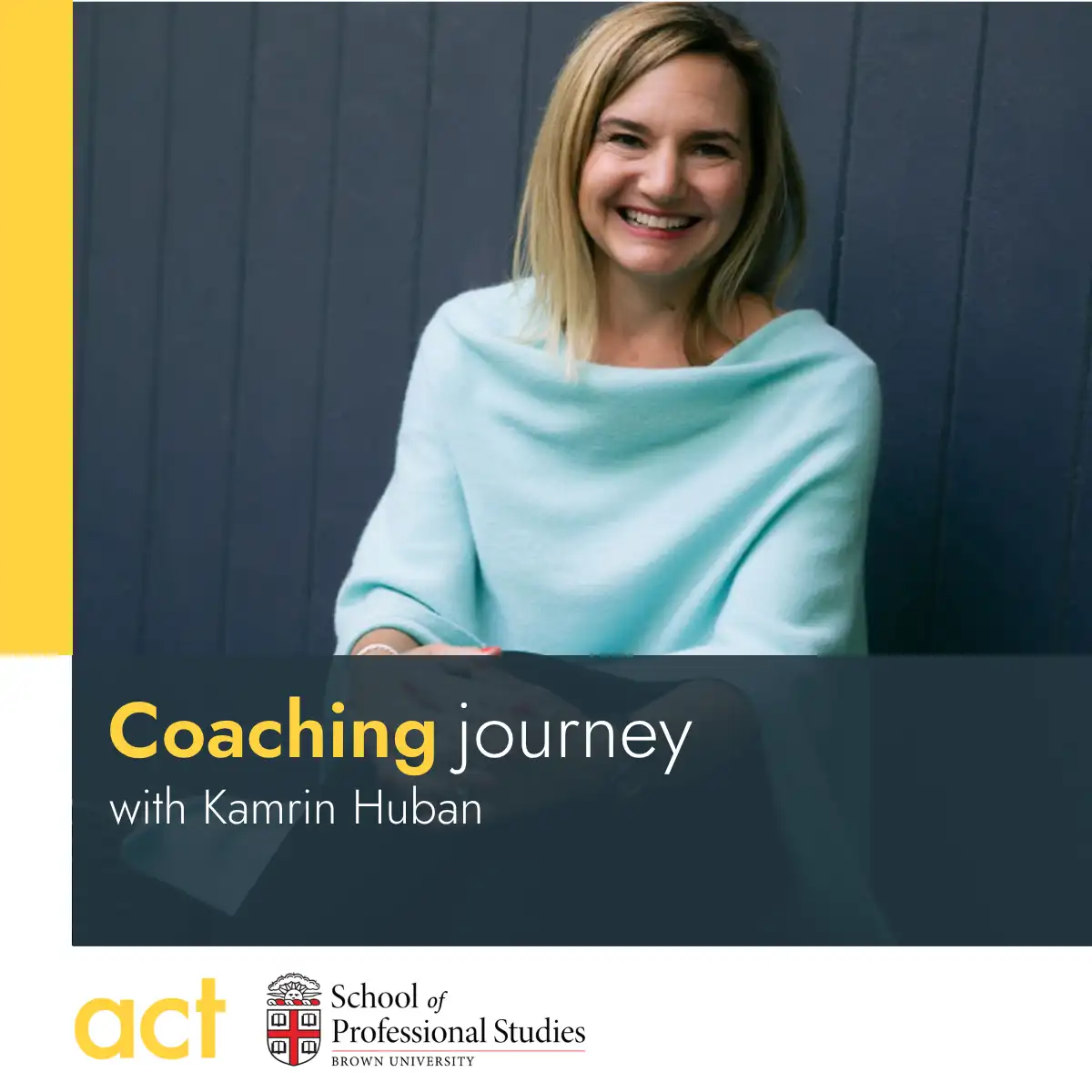

This month, we're excited to spotlight Kamrin Huban, an executive leadership coach and owner of Kamrin Huban Coaching, LLC. Kamrin's journey into coaching was shaped by her own experience being coached during a VP leadership trajectory at adidas, and later, by watching coaching get sidelined as a "last resort" tool during her time at Coach. Her story is one of turning personal insight, including her own experience with ADHD, into a coaching practice built on presence over fixing. Since completing the LPCC program, she's launched the 50, Not Dead podcast and community for women leaders, earned her PCC credential, and is now channeling her operations background into a new focus: helping organizations navigate the human side of AI transformation.
What brought you into the world of coaching?
There were three experiences that ultimately drew me to coaching.
The first was working internationally for adidas in Vietnam and Germany, where I had the opportunity to work with an executive coach, Dr. Kai Hack, while on a VP leadership trajectory. Through that experience, I gained a much deeper understanding of my strengths, motivations, and the situations that brought out my best work. It was one of the first times I experienced the transformative power of being truly seen, challenged, and developed as a leader.
The second came when I joined Coach. I was surprised to discover that coaching was often viewed as a last resort for struggling executives rather than as a tool for growth and development. In a fast-paced, high-pressure environment, it felt like a missed opportunity. I had seen firsthand how coaching could help talented people thrive long before they reached a crisis point.
The third was deeply personal. Like many high achievers, I had become consumed by my work. Over time, I realized I had built much of my identity around professional success while neglecting other important parts of my life. I knew firsthand how isolating that could feel, and I became passionate about helping others reconnect with who they are beyond their titles and accomplishments.
That combination of experiences led me to enroll in Brown University's coaching program with ACT Leadership. Coaching brought together everything I cared about: leadership, human development, and helping people gain the clarity and confidence to create lives and careers that truly fit who they are.
What inspires your passion for coaching?
What inspires my passion for coaching is witnessing the moment someone sees themselves differently. The instant when something clicks, a new possibility emerges, and confidence begins to replace uncertainty. I never tire of seeing that happen. What continues to surprise me is the intuition and insight that can emerge when two people are fully present in conversation. It is remarkably awe-inspiring.
As someone with ADHD, I have always been drawn to learning, growth, and intellectual challenge. Of course, because of ADHD, all of those things are often competing for my attention at the same time. Pursuing my PCC credential deepened my appreciation for the rigor behind great coaching. Not just the rigor of fitting more information into my head, but the real rigor required for less “doing”.
That was a surprising lesson for someone who naturally identifies as a fixer. Coaching has taught me that my best work happens when I can get my brain to stop trying so hard. Honestly, when I can get the "do-it-right" part of my brain to just sod off for a bit, that's when I do my best coaching. When I stop searching for answers then I am able create space for clients to discover their own. Learning to trust that process is on-going, but the practice of it has been one of the greatest gifts of my career.
What skills that you learned from the LPCC program have you found most useful in your professional life? Do you have any advice on how to cultivate those skills?
Probably the most useful skill—and one I still have to practice every day—is remembering that every person I work with is creative, resourceful, and whole. It isn't my job to fix them. Ironically, my toughest coaching client isn't a client at all, it's my teenager. I've learned to pause. To acknowledge that I've heard. To resist the urge to solve. And to come back to the conversation later. In management, it has been a game-changer for my ability to delegate. I used to be terrible at delegating. Now I love it.
What are the current or upcoming challenges you're facing in the coaching field? How have you been meeting those challenges?
The economic uncertainty (and the onset of AI) over the last few years has changed how people think about investing in coaching. My business slowed. And when it did, I hired a coach. The first thing I was able to uncover was that coaching at all was better than not coaching, so I took on more pro bono clients. Being an active coach, shifts how I feel. When I feel good, my interactions with people are good. It also allows me to be creative, resourceful, and whole in how I structure offers.
Do you have any special projects that you're working on? Could you share any details?
I've been intentionally following a self-designed curriculum of AI courses (many through LinkedIn Learning). My question has evolved from "How can AI help me to be a more efficient and effective business owner and coach?" to "How can I become exceptionally good at helping people and organizations work effectively with AI?" That shift has become a really exciting part of my professional journey because it has helped me formulate the idea that I want to help organizations navigate the human side of AI transformation, not just be good at navigating the technology itself.
Where do you hope your coaching journey will take you next? Or 5 years from now?
Based on what I just shared above, I am hoping to take my coaching back into the corporate world. I’ve been a solo coach for 6 years and it has been really wonderful but I want to be an integrated part of the future of work. I hope to blend my coaching skills with my operational leadership skills to help translate, give visibility to, and support an organization in understanding and mitigating the human impact so much change, uncertainty and stress can have as people and businesses continue to adapt to a very rapidly changing world. My functional expertise is in Operations/Sourcing, what I’m working on right now is the correct positioning for this work. HRBP for Ops sort of, but I don’t have the technical HR background. The title may still evolve, but the work itself feels clear to me.
How has ACT / Brown helped shape the path you've taken (or plan to take) in your coaching journey?
ACT didn't just teach me how to coach. It fundamentally changed how I think about people, leadership, and myself. The LPCC program became the foundation of my coaching practice, but more importantly, it became the foundation of how I move through the world. Nearly every meaningful professional opportunity I've had over the last six years traces back, in some way, to what I learned there.
Please share some of your recent accomplishments (since completing the LPCC program).
Since graduating from the LPCC program, I've had the privilege of building a coaching business from the ground up. Along the way I've become a much stronger networker, launched the 50, Not Dead podcast and community for women leaders, earned certifications in Mental Fitness and HAIL Transition Facilitation, and, this January, achieved one of my proudest professional milestones: earning my PCC credential.
Is there anything else you'd like to share with the ACT Alumni Community?
One of the greatest gifts of ACT is the community itself. There are fascinating people here from all over the world, and I'd genuinely love to know more of you. Please don't hesitate to reach out.
Connect with Kamrin:
50, Not Dead podcast: Apple Podcasts
our alumni